tendermint
tendermint — a Bitmark L2 proof-of-concept
A working PoC of a Tendermint (CometBFT) + EVM sidechain for Bitmark,
with a real two-way BTMK ⇄ wBTMK bridge, a validator bound to a did:nostr
identity, and an on-chain “Marks” gifting contract — all driven from a
no-build, browser-native ESM / JSON-LD dashboard.
Status: proof-of-concept, run against the live Bitmark network with real (and largely worthless 🙂) BTMK. Not production. The peg is a single-operator federation; see caveats below.
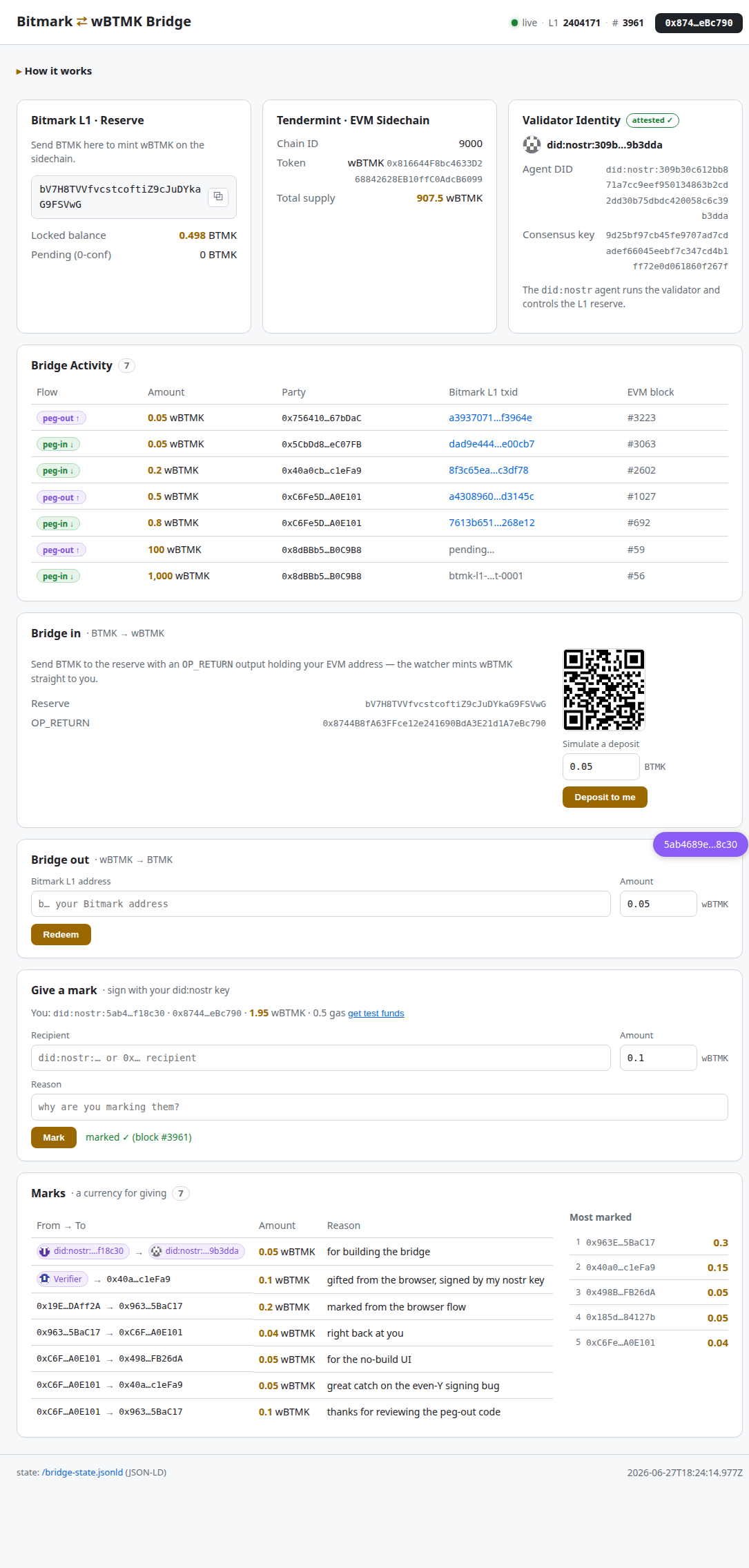
The no-build dashboard: bridge in (deposit), give marks by
did:nostr, bridge out (redeem) — the full round-trip in the browser, over a live Bitmark bridge.
→ The design rationale, trust model, and honest limits are in
docs/ARCHITECTURE.md.
Why
The pieces exist separately — Tendermint+Bitcoin (Nomic, Babylon) and EVM+Bitcoin (Rootstock, Botanix) — but Tendermint + EVM + a Bitcoin-family peg together is an under-explored cell. Bitmark is a good host: it isn’t Bitcoin (no tribal politics), it already hardened L1 with multi-algo PoW (MPoW6), and we control the chain. The sidechain adds what L1 can’t do: ~3s deterministic finality and smart contracts.
Architecture
  Bitmark L1  (MPoW6 PoW · ElectrumX: electrum.bitmark.rocks:50002)
     │  deposit BTMK ──▶ peg-watcher.js  ──▶  wBTMK.pegMint        (mint)
     │  release BTMK ◀── redeem-watcher.js ◀── wBTMK PegBurn       (burn)
     ▼
  Tendermint / EVM sidechain   (CometBFT + evmos · chainId 9000 · ~3s final)
     ├─ wBTMK            bridged Bitmark, ERC-20
     ├─ Marking.sol      "a currency for giving" — gift wBTMK with a reason
     └─ validator  ⇄  did:nostr   (consensus key in the DID doc + on-chain
                                    description + a BIP340-signed attestation)
              ▲
  ui/  — no-build ESM dashboard polling  /bridge-state.jsonld  (JSON-LD)
Proven live (real coins)
- Peg-in: 0.8 BTMK deposited (
7613b651…268e12) → 0.8 wBTMK minted, the L1 txid recorded in thePegMintevent. - Peg-out: burned 0.5 wBTMK → 0.5 BTMK released on L1 (
a4308960…d3145c), change returned to the reserve. - Identity: the running validator’s Ed25519 consensus key is asserted in the
DID doc, the chain points back via
description.details, and the DID key signed an attestation over it — all verifiable withscripts/verify-binding.sh. - Marks: four real on-chain gifts between accounts, with reasons + identity tags and a “most marked” leaderboard.
Quickstart
Needs evmosd (evmos v20 prebuilt binary), Node 20+, and Foundry.
# 1. start the single-validator Tendermint/EVM devnet (JSON-RPC :8545)
./scripts/start-chain.sh

# 2. deploy wBTMK + Marking (writes evm/deployment.json, read by everything)
./scripts/deploy.sh

# 3. bridge + UI
npm run watch    # peg-in:  Bitmark deposits  -> wBTMK
npm run redeem   # peg-out: wBTMK burns       -> Bitmark releases
npm run ui       # dashboard at http://localhost:8080
Or, once the contracts are deployed, bring up the whole stack (chain + both watchers + UI) with one command and tear it down with another:
./scripts/demo-up.sh      # http://localhost:8080
./scripts/demo-down.sh
In the UI you can connect a Nostr identity (xlogin), bridge in (deposit to your address), give marks (gift wBTMK with a reason, tagged by did:nostr), and bridge out (redeem to Bitmark L1) — the full round-trip, no scripts.
Full details, the exact peg/identity/Marks flows, and the honest trust model are
in evm/README.md.
Repo layout
| Path | What |
|---|---|
scripts/ |
start/stop the single-validator chain; verify-binding.sh |
evm/*.sol |
wBTMK (bridged token) and Marking (gifting) contracts |
evm/electrum.js, btmk.js, btmk-tx.js |
Bitmark L1: ElectrumX client, addresses, tx signer (pure JS) |
evm/peg-watcher.js, redeem-watcher.js |
the two-way bridge |
evm/server.js |
zero-dep server: static UI + live /bridge-state.jsonld |
ui/ |
no-build ESM dashboard (semantic HTML + data-island hydration) |
agent.did.json |
the agent’s did:nostr identity, wired to the validator |
Caveats (it’s a PoC)
- The peg is single-operator. A sidechain’s security ceiling is its peg custody + validator set, not Bitmark’s hashpower — same as every L2. This is “Liquid’s trust model, traded for programmability and speed.”
- Single validator — fast and final, but not decentralised or BFT (BFT needs ≥ 4). It’s a fast, trusted sequencer for the PoC.
- Test keys — the
0xE9B1…deployer key in the code is the public, documented evmos local-test key. Don’t use it anywhere real. - Committed identity/attestation reflect the demo chain instance; a fresh
start-chain.shgenerates a new consensus key.
🤖 Built with Claude Code.